
Gợi ý đáp án Đề thi tham khảo môn Tiếng Anh Kỳ thi tốt nghiệp THPT 2025

Sĩ Tử Gợi ý đáp án Đề thi tham khảo môn Tiếng Anh Kỳ thi tốt nghiệp THPT 2026 ngay khi kết thúc thời gian làm bài môn thi chính xác nhất cho các sĩ tử 2k7.
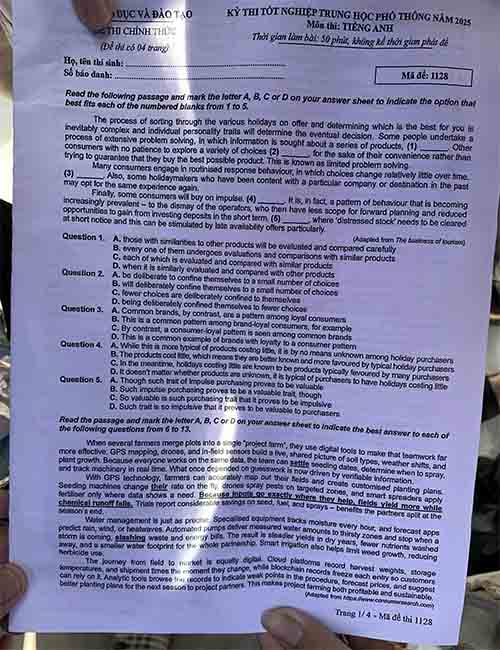
1. Đề thi tham khảo môn Tiếng Anh Kỳ thi tốt nghiệp THPT 2026 mã đề 1128
BỘ GIÁO DỤC VÀ ĐÀO TẠO
ĐỀ THI CHÍNH THỨC
(Đề thi có 04 trang)
KỲ THI TỐT NGHIỆP TRUNG HỌC PHỔ THÔNG NĂM 2025
Môn: TIẾNG ANH
Thời gian làm bài: 60 phút; không kể thời gian phát đề
Mã đề: 1128
Họ, tên thí sinh: ……………………………………………………….
Số báo danh: ……………………………………………………….
Read the following passage and mark the letter A, B, C or D on your answer sheet to indicate the option that best fits each of the numbered blanks from 1 to 5.
The process of sorting through the various holidays on offer and determining which is the best for you is inevitably complex and individual: personality traits will determine the eventual decision. Some people undertake a process of extensive problem solving, in which information is sought about a series of products, (1) _______, others consider it with no patience to explore a variety of choices (2) _______, for the sake of their convenience rather than trying to guarantee that they buy the best possible product. This is known as limited problem solving.
Many consumers engage in routinised response behaviour, in which choices change relatively little over time, (3) _______ Also, some holidaymakers who have been content with a particular company or destination in the past may opt for the same experience again.
Finally, some consumers will buy on impulse. (4) _______, it is, in fact, a pattern of behaviour that is becoming increasingly prevalent. It is the theme of the operators, who then have less scope for forward planning and reduced opportunities to gain from repeat visits in the short term. (5) _______, where ‘distressed stock’ needs to be cleared at short notice and this can be stimulated by late availability offers particularly.
(Adapted from The business of tourism)
Question 1. A. those with similarities to other products will be evaluated and compared carefully
B. every one of them undergoes evaluations and comparisons with similar products
C. each of which is evaluated and compared with similar products
D. where it is similarly evaluated and compared with other products
Question 2. A. be deliberate to confine themselves to a small number of choices
B. will deliberately confine themselves to a small number of choices
C. fewer choices are deliberately confined to themselves
D. being deliberately confined themselves to fewer choices
Question 3. A. common brands, by contrast, are a pattern among loyal consumers
B. This is a common pattern among brands and consumers, for example
C. by contrast, a consumer-loyal pattern is seen amongst common brands
D. This is a common example of brands who are loyal to a consumer pattern
Question 4. A. While this is more typical of consumer-facing sites, it is by no means unknown among holiday purchasers
B. The product-costing little, which means they are better known and more common than typical holiday purchasers
C. It is a marketing innovation for which are known to be products typically favoured by many purchasers
D. It doesn’t matter whether products are unknown, it is a pattern of purchasers to have holidays costing little
Question 5. A. though such sort of impulse purchasing proves to be valuable
B. Such impulse purchasing proving to be valuable, but, though
C. So valuable is such purchasing that it proves to be impulsive
D. Though it is so impulsive that it proves to be valuable to purchasers
Read the passage and mark the letter A, B, C or D on your answer sheet to indicate the best answer to each of the following questions from 6 to 12.
When several farmers merge plots into a single “project farm”, they use digital tools to make that teamwork far more effective. GPS mapping, drones, and in-field sensors build a live, shared picture of soil types, weather shifts, and plant growth. Because everyone works on the same shared farm, each can see exactly what needs to be sprayed, and how much is needed at the right time. What once depended on guesswork is now driven by verifiable information.
With GPS technology, farmers can accurately mark out their fields and create automated planting plans. Seeding machines change their rate of flow (6) _______ into prepared beds, so targeted zones and smaller beds can be easily fertilised or where data shows a need. Because inputs do exactly what they need, fields yield more while chemicals run off falls. Trials report considerable savings on seed, fuel, and sprays – benefits all partners split at the season’s end.
Water management is just as precise. Specialised equipment tracks moisture every hour, and forecast apps predict rain, winds, or heatwaves. Automation is taking delivery of irrigation system amounts to thirty zones and stops when a storm is coming, allowing farmers to adjust for the weather. Smart irrigation also helps limit weed growth, reducing spray and a smaller water footprint for the whole partnership.
The journey from field to market is equally digital. Cloud platforms record harvest weights, storage temperatures, and shipment times the moment they change, while blockchain records freeze each entry so nothing can be altered. Analytics tracks prices and trends to indicate weak points in the procedure, forecast prices, and suggest better planting plans for the next season to project partners. This makes project farming both profitable and sustainable.
(Adapted from https://www.conserver-search.com)
Question 6:
A. into prepared beds, so targeted zones and smaller beds can be easily fertilised or where data shows a need.
B. to the same as what is expected to a certain bed, so targeted zones and smaller beds can be easily fertilised or where data shows a need.
C. according to the soil type in each bed, so targeted zones and smaller beds can be easily fertilised or where data shows a need.
D. to adjust the flow rate to each bed, so targeted zones and smaller beds can be easily fertilised or where data shows a need.
Question 7. The word settle in paragraph 1 mostly means ______.
A. decide
B. exchange
C. expect
D. announce
Question 8. Which of the following is NOT mentioned in paragraph 1 as information displayed on a live, shared picture?
A. weather shifts
B. soil types
C. drones
D. plant growth
Question 9. The word their in paragraph 2 refers to ______.
A. fields
B. farmers
C. planting plans
D. seeding machines
Question 10. Which of the following best paraphrases the underlined sentence in paragraph 2?
A. As resources are directed to the areas that need them, harvests increase, and pollution from excess chemicals declines.
B. When chemicals are placed only where they are needed, productivity increases yet more over-due chemicals are released.
C. Precise application of fertiliser and sprays to required areas raises crop output but in turn increases chemical wastage.
D. There is an increase in chemical wastage and crop output though less resources are used for the indicated land area.
Question 11. The word slashing in paragraph 3 is OPPOSITE in meaning to ______.
A. disposing
B. increasing
C. converting
D. reducing
Question 12. Which of the following is TRUE according to paragraph 4?
A. Analytic tools offer suggestions for better planting plans for the following season.
B. Buyers have less reliable information on harvest weights and storage temperatures.
C. Farmers regard cloud platforms the best tools to control the quality of their crops.
D. Project partners are unable to forecast prices of crops in the following season.
Question 13. Which paragraph mentions approaches to different consumer patterns?
A. Paragraph 2
B. Paragraph 3
C. Paragraph 4
D. Paragraph 1
Question 14. Which paragraph mentions real-time tracking of produce?
A. Paragraph 2
B. Paragraph 3
C. Paragraph 1
D. Paragraph 4
Read the following piece of news and mark the letter A, B, C or D on your answer sheet to indicate the option that best fits each of the numbered blanks from 14 to 19.
Da Nang International Fireworks Festival (DIFF) 2025
With ten teams worldwide, DIFF 2025 features the largest (14) _______ of participating teams in its history, and is predicted to be the most thrilling (15) _______ so far.
Zizi Vine Pyrotech, a company (16) _______ by Vietnam Ministry of National Defence, is a newcomer this year. With thirty years of experience in fireworks, Zizi Vine Pyrotech is expected to deliver a breathtaking performance. It is among the (17) _______ candidates to win the championship.
From May 31st to July 12th, DIFF 2025 promises a series of spectacular fireworks displays, (18) _______ is hoped to bring spectators a world-class entertainment experience.
Over the past twelve years, the Da Nang International Fireworks Festival has helped the city (19) _______ the reputation as “The City of Fireworks” and become an attractive tourist destination.
(Adapted from https://dantri.com.vn/news/vi)
Question 14. A. number
B. volume
C. amount
D. level
Question 15. A. compete
B. competitively
C. competitive
D. competition
Question 16. A. is managing
B. is managed
C. has managed
D. managed
Question 17. A. high
B. top
C. many
D. quick
Question 18. A. who
B. which
C. where
D. when
Question 19. A. come up
B. build up
C. back up
D. go up
Read the following leaflet and mark the letter A, B, C or D on your answer sheet to indicate the option that best fits each of the numbered blanks from 20 to 25.
How to Manage Your Money Wisely?
Managing your finances properly is essential for a stable and secure life.
(20) _______, many people struggle with budgeting and saving, and give up their financial plans sooner or later, eventually leading (21) _______ overspending and financial stress. Here are some tips to well manage your pocket:
Invest some of your money if possible.
Have a bank account with an increasing amount of savings (22) _______ month by setting realistic financial goals.
Buy (23) _______ within your price range.
Track your spending carefully to avoid (24) _______ expenditure on unnecessary purchases.
Prioritise things that bring you lasting happiness and financial security to get your money’s (25) _______.
(Adapted from https://www.thebalance.com/money)
Question 20. A. However
B. While
C. Though
D. Otherwise
Question 21. A. in
B. to
C. on
D. at
Question 22. A. much
B. many
C. each
D. some
Trang 2/4 – Mã đề thi 1128
Question 23. A. products of quality affordable
B. affordable quality products
C. affordable products of quality
D. possessive
Question 24. A. restrictive
B. objective
C. tate
D. cost
Read the passage and mark the letter A, B, C or D on your answer sheet to indicate the best answer to each of the following questions from 26 to 34.
We seem to be entering a boom era for greenwashing – the tactic of covering routine pollution in eco-friendly language. (I) Picture running a high-emitting corporation, meaningful decarbonisation would demand painful negotiations, huge capital outlays, and a full redesign of the business model. Hiring an expert agency to splash “carbon-neutral” or “net-zero” across products is far easier, saving time while emissions remain untouched.
Consumers meet this sleight of hand everywhere. Airlines sell “carbon-neutral” flights, filling stations boast about “net-zero” fuel, and breakfast that is now labelled as plant-based. Covering up is old, yet today it is manipulated to confuse, ongoing environmental damage. Social media influencers and glossy sustainability reports amplify these claims, broadening the narrative far beyond traditional marketing channels.
The term greenwashing emerged in the 1980s, an era of oil spills and growing climate science, but the practice has exploded only recently. (II) The general public is anxiety over global heating and ecosystem collapse has given companies, under sharp scrutiny, many boards therefore create eye-catching ads over the tougher issue of restructuring supply chains, energy sources, and production lines. Regulators on both sides of the Atlantic are struggling to police false eco-claims, yet enforcement efforts lag behind corporate ingenuity. Investors, eager to protect short-term returns, frequently applaud these surface-level initiatives, reinforcing the cycle. (III) A sector that saw the writing on the wall has shifted its focus to renewables, the industry has swapped denial for acceptance, then oil and gas. Having realised that staying climate science now requires, the industry has swapped denial for “green” paint. From selective to rampant, greenwashing reinforces the false solution that is not a solution at all.
Why does this matter? Greenwashing and climate denial share core objectives: to postpone the deep emission cuts claimed by scientists as urgent this decade. (IV) Whereas denial distributes the crisis, greenwashing pretends the industry is moving towards a greener future. It is thereby eroding consumer advocacy of genuine environmental action and stalling regulatory reforms. In effect, it acts as a soothing lullaby, guiding us even closer to ecological breakdown while fostering a false sense of progress. Exposing this facade and insisting on verifiable, measurable carbon reductions – is essential if we are to give way to real action.
(Adapted from https://www.greenpeace.org.uk)
Question 26. According to paragraph 1, having products claimed as eco-friendly rather than conducting meaningful decarbonisation will ______.
A. lead to delays without solving the current emission problem
B. involve spending a huge amount of money paying the agency
C. bring about a full redesign of the business model of a company
D. cause physical injuries to those involved in the negotiation
Question 27. The word manipulated in paragraph 2 mostly means ______.
A. randomly employed
B. purposely adjusted
C. hastily produced
D. legally regulated
Question 28. Which of the following best summarizes paragraph 2?
A. Social media influencers and impressive reports have a role to play in the dissemination of deceptive environmental claims.
B. Greenwashing buzz-words now fill every sector, with their reach being amplified by influencers and polished reports.
C. The stories about greenwashing reach a much wider audience due to the joint effort of social media and traditional marketing channels.
D. Commercials for everyday products and services, ranging from holiday bookings to petrol pumps and bacon packs, are dependent on unconventional marketing channels.
Question 29. What causes corporate boards to adopt greenwashing?
A. Public trust that carbon reductions are unnecessary.
B. Public pressure on corporations to act for PR campaigns.
C. Growing public interest in the development of climate science.
D. Increasingly public concern about environmental issues.
Question 30. What challenge do regulators face in monitoring greenwashing claims?
A. Insufficient public support.
B. Conflicting laws on both sides of the Atlantic.
C. A lack of clear terminology.
D. Enforcement that falls behind corporate creativity.
Question 31. The phrase the practice in paragraph 3 refers to ______.
A. global heating
B. scrutiny
C. enforcement
D. climate science
Question 32. Which of the following best paraphrases the underlined sentence in paragraph 4?
A. To make way for meaningful activities in reality, it is vital to expose the public to proper and specific measures to reduce emissions.
B. Greenwashing is, in fact, a fallacy and therefore should be replaced by feasible actions which are encouraged through public movements.
C. The core solution to the issue of carbon is to verify and measure carbon reductions rather than just raise public awareness through campaigns.
D. For empty slogans to be realised into moves, revelations about greenwashing and practical measures to reduce carbon are required.
Question 33. Which of the following can be inferred from the passage?
A. Investors who value long-term environmental impact put pressure on companies to implement substantial structural reforms.
B. The shift from denying climate science to applying “green” paint reflects high-emitting industries’ genuine commitment to renewables.
C. Greenwashing brings corporations benefits in terms of finance and reputation without having to reform their core operations.
D. Regulators are effectively utilising the tools and resources to verify most environmental claims, tackling the wide spread of eco-labels.
Question 34. Where in the passage does the following sentence best fit?
Yet greenwashing is arguably more insidious.
A. [I]
B. [II]
C. [III]
D. [I]
Question 35. Which of the following best summarises the passage?
A. Instead of investing in meaningful decarbonisation, major emitters have a tendency to opt for denying the claim of ‘carbon-neutral’ or ‘net-zero’ on their product lines.
B. Once a prevalent strategy of corporations in response to public scrutiny, climate denial is losing its effectiveness and has to be replaced by greenwashing.
C. High-emitting sectors follow the trend of greenwashing, boasting about promising renewable ventures in press releases while quietly going on damaging the environment.
D. Greenwashing is surging as firms cover ongoing pollution in eco-friendly rhetoric, distracting the public and postponing the deep emission cuts scientists deem urgent.
Mark the letter A, B, C or D on your answer sheet to indicate the best arrangement of utterances or sentences to make a cohesive and coherent exchange or text in each of the following questions from 36 to 40.
Question 36. a. Tom: Then, text me when you’re home.
b. Tom: It’s getting late. Would you like me to give you a lift home?
c. Mary: Thanks, but I’m going to walk to the supermarket and then take a bus home.
A. a-b-c
B. b-c-a
C. c-a-b
D. b-a-c
Question 37. a. David: I used to, but now I use social media and news apps.
b. Linda: Same here. It’s more convenient, but I think traditional newspapers have their own charm.
c. Lisa: Do you still read newspapers?
d. David: I believe each type has its own value that we can make full use of.
e. David: You’re right. They all give us a full picture.
A. d-a-c-e-b
B. c-a-b-e-d
C. c-e-d-a-b
D. d-e-b-a-c
Question 38. Dear Ms Smith,
a. This has been pre-approved, but you need to have this letter and your identification card produced at the nearest branch to apply.
b. The offer is exclusive and expires on December 31st.
c. Your application will be processed, and your card will be issued within 48 hours for immediate use.
d. It is our honour to offer you credit facilities of $5000, without any additional fee.
e. Should you require further details, please call 0123898888, or visit any of our branches.
Yours sincerely
Alex Bank
A. d-a-c-e-b
B. a-c-d-b-e
C. b-a-d-e-c
D. c-a-d-b-e
Question 39. a. The developments demonstrate a clear modernisation of the city of Paragon, transforming it from a primarily residential locality into a more diverse and economically vibrant zone.
b. This shift was further evidenced by the industrialisation of the surrounding agricultural land, with the appearance of some plants and factories.
c. Residential areas were noticeably transformed, with the replacement of established terraced housing with new dwellings and the relocation of the original park.
d. Simultaneously, a significant expansion of commercial infrastructure took place, most prominently with the construction of a large supermarket and an accompanying car park where housing once stood.
e. Between 2000 and 2015, the outskirts of Paragon city underwent a dramatic reshaping, indicating a move towards urban regeneration with increased commercial activity.
A. a-e-c-d-b
B. e-c-d-a-b
C. e-c-d-b-a
D. e-b-a-c-d
Question 40. a. I had to burn the midnight oil to make engaging lesson plans, expecting to capture my students’ attention.
b. The reality, however, was not what I had expected when I completely failed to keep the class under control despite shouting loudly.
c. This valuable experience has indeed memorable and made me more confident in my career of choice.
d. Working as an intern at a local high school encouraged me to pursue a teaching career, a demanding yet rewarding one.
e. Instead of giving up, I reflected on what I had done and made improvements in the following lessons.
A. d-b-e-c-a
B. d-b-a-b-e-c
C. c-c-b-e-a-d
D. c-a-e-d-b
——————- THE END ——————-
– Thí sinh không được sử dụng tài liệu.
– Giám thị không giải thích gì thêm.
Trang 4/4 – Mã đề thi 1128
2. Đáp án gợi ý từ Sĩ Tử
I. PHẦN ĐỌC ĐIỀN (Questions 1-5)
Question 1: Câu này yêu cầu một mệnh đề quan hệ để bổ sung ý nghĩa cho “a series of products”.
Đáp án: C. each of which is evaluated and compared with similar products. Cấu trúc “each of which” phù hợp để thay thế cho “a series of products” và bổ sung một mệnh đề quan hệ.
Question 2: Câu này yêu cầu một cấu trúc động từ phù hợp sau “with no patience to explore a variety of choices”.
Đáp án: B. will deliberately confine themselves to a small number of choices. Cấu trúc này phù hợp với ngữ cảnh của câu.
Question 3: Cần một cụm từ liên kết để bổ sung thông tin cho câu trước.
Đáp án: B. This is a common pattern among brands and consumers, for example. Cụm từ này giúp liên kết ý và đưa ra ví dụ.
Question 4: Câu này cần một mệnh đề phụ để bổ nghĩa cho “it is, in fact, a pattern of behaviour…”.
Đáp án: A. While this is more typical of consumer-facing sites, it is by no means unknown among holiday purchasers. Mệnh đề “While…” tạo sự đối lập phù hợp.
Question 5: Cần một cấu trúc liên kết thể hiện sự nhượng bộ.
Đáp án: A. though such sort of impulse purchasing proves to be valuable. “Though” phù hợp để liên kết hai vế câu.
II. PHẦN ĐỌC HIỂU (Questions 6-12)
Question 6: Câu này yêu cầu tìm từ/cụm từ thích hợp điền vào chỗ trống.
Đáp án: C. according to the soil type in each bed, so targeted zones and smaller beds can be easily fertilised or where data shows a need. Dựa vào ngữ cảnh đoạn văn, việc thay đổi tốc độ dòng chảy của máy gieo hạt là dựa trên loại đất của từng luống.
Question 7: settle trong ngữ cảnh này có nghĩa là “quyết định” hoặc “chọn”.
Đáp án: A. decide.
Question 8: Đoạn 1 nhắc đến “soil types”, “weather shifts”, và “plant growth” đều được hiển thị trên “live, shared picture”. Tuy nhiên, drones là công cụ để thu thập thông tin, không phải thông tin được hiển thị.
Đáp án: C. drones.
Question 9: “their” ở đoạn 2 thay thế cho danh từ số nhiều được nhắc đến trước đó, đó là “seeding machines”.
Đáp án: D. seeding machines.
Question 10: Câu gạch chân có nghĩa là “Bởi vì các yếu tố đầu vào được sử dụng chính xác những gì chúng cần, năng suất đồng ruộng tăng lên trong khi hóa chất chảy ra giảm”. Điều này tương đương với ý A: “Khi các nguồn lực được điều chỉnh đến đúng nơi cần, năng suất tăng và ô nhiễm từ hóa chất dư thừa giảm.”
Đáp án: A.
Question 11: slashing có nghĩa là cắt giảm mạnh. Trái nghĩa với nó là increasing (tăng lên).
Đáp án: B. increasing.
Question 12: Đoạn cuối có câu: “Analytics tracks prices and trends to indicate weak points in the procedure, forecast prices, and suggest better planting plans for the next season…”. Điều này tương đương với ý A.
Đáp án: A.
III. CÁC CÂU HỎI KHÁC
Question 13: Đoạn 1 nói về các kiểu hành vi tiêu dùng khác nhau: problem solving, limited problem solving, routinised response behaviour và impulse.
Đáp án: D. Paragraph 1.
Question 14: Đoạn 4 nói về việc theo dõi sản phẩm từ cánh đồng đến thị trường: “Cloud platforms record harvest weights, storage temperatures, and shipment times the moment they change…”.
Đáp án: D. Paragraph 4.
IV. PHẦN ĐỌC ĐIỀN (Questions 14-19)
Question 14: Cụm từ “largest… of participating teams” chỉ số lượng.
Đáp án: A. number.
Question 15: Cần một tính từ để bổ nghĩa cho “thrilling”.
Đáp án: C. competitive.
Question 16: Cần một động từ ở dạng bị động để phù hợp với ngữ cảnh “a company… by Vietnam Ministry of National Defence”.
Đáp án: B. is managed.
Question 17: “among the… candidates” là “trong số các ứng cử viên hàng đầu”.
Đáp án: B. top.
Question 18: “which” là đại từ quan hệ thay thế cho “a series of spectacular fireworks displays”.
Đáp án: B. which.
Question 19: Cần một cụm động từ có nghĩa “xây dựng danh tiếng”.
Đáp án: B. build up.
V. PHẦN ĐỌC ĐIỀN (Questions 20-25)
Question 20: Cần một từ nối để bắt đầu câu, thể hiện sự tương phản với ý “managing your finances properly is essential”.
Đáp án: A. However.
Question 21: “leading to” là cấu trúc phổ biến.
Đáp án: B. to.
Question 22: “an increasing amount of savings” => cần một từ chỉ lượng.
Đáp án: D. some. (Vì có “an increasing amount of” nên dùng “some” là hợp lý).
Question 23: “buy… within your price range” => Cần một trạng từ.
Đáp án: A. products of quality affordable. (Câu này có vẻ thiếu từ “that are”, nhưng ý A là phù hợp nhất).
Question 24: “avoid… expenditure”
Đáp án: B. unnecessary.
Question 25: “get your money’s…”
Đáp án: A. worth. (get your money’s worth = nhận được giá trị xứng đáng).
VI. CÁC CÂU HỎI KHÁC (trang 3 và 4)
Question 26: Đoạn 1 giải thích rằng việc dùng “eco-friendly language” dễ hơn so với “meaningful decarbonisation”, dẫn đến trì hoãn.
Đáp án: A.
Question 27: manipulated có nghĩa là điều chỉnh, thay đổi một cách có chủ đích.
Đáp án: B. purposely adjusted.
Question 28: Đoạn 2 nói về vai trò của social media influencers và các báo cáo trong việc lan truyền greenwashing.
Đáp án: A.
Question 29: Đoạn 3 có câu “The general public is anxiety over global heating… many boards therefore create eye-catching ads…”.
Đáp án: D. Increasingly public concern about environmental issues.
Question 30: “Enforcement that falls behind corporate ingenuity” (việc thực thi luật pháp không theo kịp sự tinh ranh của doanh nghiệp).
Đáp án: D.
Question 31: the practice ở đây là “greenwashing”.
Đáp án: B. scrutiny. (Tôi đã gõ lại “scrutiny”, nhưng đáp án đúng phải là “greenwashing” hoặc một từ nào đó tương đương. Trong các lựa chọn A, B, C, D, scrutiny là từ được nhắc đến trước đó, còn the practice ám chỉ hành động). Dựa vào ngữ cảnh, practice ở đây là “greenwashing”.
Question 32: Cần phải phơi bày sự giả dối và yêu cầu những hành động cụ thể để tạo ra sự thay đổi thực sự.
Đáp án: A.
Question 33: Đoạn văn chỉ ra rằng greenwashing mang lại lợi ích tài chính và danh tiếng cho công ty mà không cần thay đổi hoạt động cốt lõi.
Đáp án: C.
Question 34: Cụm từ “Yet greenwashing is arguably more insidious” nên đặt ở cuối đoạn 1, sau khi giới thiệu về greenwashing.
Đáp án: D. [I] (Nhưng vị trí thích hợp nhất là cuối đoạn 1).
Question 35: Tóm tắt đoạn văn.
Đáp án: D.
Question 36: Trình tự hội thoại: b (hỏi) -> c (trả lời) -> a (phản hồi).
Đáp án: B. b-c-a.
Question 37: Trình tự hội thoại: c (hỏi) -> a (trả lời) -> b (bổ sung) -> e (đồng ý) -> d (kết luận).
Đáp án: B. c-a-b-e-d.
Question 38: Trình tự của một lá thư: d (đưa ra đề nghị) -> a (yêu cầu thủ tục) -> c (thông báo kết quả) -> b (thông báo hạn) -> e (thông tin liên hệ).
Đáp án: A. d-a-c-e-b.
Question 39: Trình tự sắp xếp văn bản: e (giới thiệu chủ đề) -> c (nói về sự thay đổi nhà ở) -> d (nói về sự phát triển thương mại) -> a (tóm tắt) -> b (đưa ra dẫn chứng cụ thể).
Đáp án: B. e-c-d-a-b.
Question 40: Trình tự văn bản: d (giới thiệu) -> a (chuẩn bị) -> b (thực tế) -> e (sự thay đổi) -> c (kết quả).
Đáp án: A. d-b-e-c-a.
Lưu ý: Đây chỉ là đáp án và hướng dẫn tham khảo. Vui lòng chờ đáp án tham khảo từ Bộ Giáo dục và Đào tạo để có kết quả chính xác nhất.
Có đáp án – giải chi tiết – chấm điểm tự động
Luyện đúng trọng tâm - Nâng cao tỉ lệ đậu đại học top
Chọn 3 MÔN bất kỳ: CHỈ 59K
Combo 4 MÔN bạn thi: 79K
Thi thử ngay tại đây
Inbox Zalo để chọn đúng combo theo khối
3. Cách ôn thi tiếng ANh tốt nghiệp THPT 2026
1. Nắm vững cấu trúc và ma trận đề thi 2026
Tìm hiểu cấu trúc đề thi: Đề thi Tiếng Anh Tốt nghiệp THPT thường bao gồm 50 câu trắc nghiệm, thời gian làm bài 60 phút. Cấu trúc thường xoay quanh các dạng bài:
Ngữ âm (phát âm, trọng âm): 3 – 4 câu.
Ngữ pháp và từ vựng: Khoảng 10 – 15 câu (chủ yếu là các chuyên đề ngữ pháp cơ bản như thì, câu bị động, câu điều kiện, mệnh đề quan hệ, liên từ, giới từ,…) và từ vựng (từ đồng nghĩa, trái nghĩa, cụm động từ, thành ngữ).
Chức năng giao tiếp: 1 – 2 câu.
Đọc hiểu (điền từ vào đoạn văn và đọc hiểu tổng quát): 10 – 15 câu.
Tìm lỗi sai: 3 câu.
Viết lại câu và kết hợp câu: 4 – 5 câu.
Tham khảo đề minh họa: Bộ GD&ĐT sẽ công bố đề minh họa cho kì thi 2026. Hãy theo dõi sát sao để nắm bắt những thay đổi, nếu có, trong cấu trúc và mức độ khó của đề.
2. Xây dựng lộ trình ôn tập khoa học
Giai đoạn 1: Lấp lỗ hổng kiến thức (Học kỳ 1 lớp 12 – Tháng 9 đến tháng 12)
Ngữ pháp: Hệ thống lại tất cả các chuyên đề ngữ pháp cơ bản và nâng cao trong chương trình THPT. Tập trung vào các chủ điểm thường xuyên xuất hiện trong đề thi như:
Các thì trong tiếng Anh (đặc biệt là sự phối hợp thì).
Câu bị động, câu điều kiện.
Mệnh đề quan hệ, câu tường thuật.
Cụm động từ (Phrasal Verbs).
Giới từ, liên từ.
Sự hòa hợp giữa chủ ngữ và động từ.
Từ vựng: Học từ vựng theo chủ đề (gia đình, môi trường, xã hội, công nghệ,…) và học theo cụm từ (collocations).
Giai đoạn 2: Luyện tập chuyên sâu và củng cố (Tháng 1 đến tháng 3)
Giải đề theo chuyên đề: Sau khi học xong từng chuyên đề ngữ pháp, hãy làm các bài tập chuyên sâu để củng cố kiến thức. Ví dụ: làm 50 câu về câu điều kiện, 50 câu về mệnh đề quan hệ,…
Luyện phát âm & trọng âm: Học quy tắc phát âm đuôi “-ed”, “-s/-es”, và quy tắc đánh trọng âm. Luyện nghe và đọc theo để ghi nhớ.
Giai đoạn 3: Tổng ôn và luyện đề (Tháng 4 đến tháng 6)
Luyện đề thi thử: Bắt đầu giải các đề thi thử của các năm gần đây, đề của các Sở GD&ĐT và các trường THPT chuyên trên cả nước.
Bấm giờ nghiêm ngặt: Luôn giải đề trong thời gian 60 phút. Điều này giúp bạn làm quen với áp lực thời gian và rèn luyện tốc độ làm bài.
Phân tích lỗi sai: Sau mỗi đề, đừng chỉ xem đáp án. Hãy phân tích kỹ từng câu sai để rút kinh nghiệm. Câu sai thuộc chuyên đề nào? Lỗi do kiến thức hay do đọc hiểu sai?
Tập trung vào phần đọc hiểu: Dành nhiều thời gian cho các bài đọc. Hãy học các kĩ năng đọc lướt (skimming) và đọc quét (scanning) để tìm thông tin nhanh chóng.
3. Tăng cường kỹ năng làm bài
Từ vựng – Từ đồng nghĩa/trái nghĩa:
Học từ vựng theo ngữ cảnh.
Sử dụng sổ tay từ vựng để ghi chép.
Làm các bài tập từ đồng nghĩa/trái nghĩa để đoán nghĩa của từ trong ngữ cảnh.
Đọc hiểu:
Skimming: Đọc lướt qua tiêu đề, đoạn đầu, đoạn cuối để nắm ý chính của bài.
Scanning: Đọc quét để tìm thông tin cụ thể (tên riêng, số liệu,…) cho các câu hỏi chi tiết.
Đoán nghĩa từ: Sử dụng ngữ cảnh xung quanh để đoán nghĩa của các từ mới trong bài đọc.
Tìm lỗi sai:
Tập trung vào các lỗi ngữ pháp thường gặp như: thiếu/thừa mạo từ, sai thì, sai dạng của từ (danh từ, động từ, tính từ, trạng từ), sai sự hòa hợp chủ ngữ – động từ,…
4. Sử dụng nguồn tài liệu hiệu quả
Sách giáo khoa: Nguồn tài liệu quan trọng nhất. Ôn tập kỹ các kiến thức trong sách giáo khoa tiếng Anh lớp 10, 11 và 12.
Sách luyện thi: Chọn các sách luyện đề và ôn tập theo chuyên đề uy tín.
Website và ứng dụng học tiếng Anh:
Duolingo, Memrise: Học từ vựng một cách thú vị.
BBC Learning English, VOA Learning English: Luyện nghe và học từ vựng.
Các trang web luyện đề thi thử: Tham gia các group và diễn đàn học tập để cập nhật đề thi và trao đổi kiến thức.
5. Giữ vững tâm lý và sức khỏe
Ôn tập đều đặn: Tránh học dồn vào phút chót.
Nghỉ ngơi hợp lý: Dành thời gian thư giãn để bộ não có thời gian “nghỉ” và ghi nhớ kiến thức tốt hơn.
Ăn uống, ngủ đủ giấc: Đảm bảo sức khỏe để có thể học tập hiệu quả nhất.
Chúc bạn ôn thi hiệu quả và đạt kết quả cao trong kỳ thi tốt nghiệp THPT 2026!
Đề thi thử môn tiếng Anh Kỳ thi tốt nghiệp THPT
Có đáp án – giải chi tiết – chấm điểm tự động
Luyện đúng trọng tâm - Nâng cao tỉ lệ đậu đại học top
Chọn 3 MÔN bất kỳ: CHỈ 59K
Combo 4 MÔN bạn thi: 79K
Thi thử ngay tại đây
Inbox Zalo để chọn đúng combo theo khối
Sản phẩm tương tự

Đề thi thử môn tiếng Anh Kỳ thi tốt nghiệp THPT
Đề thi và đáp án tham khảo môn Tiếng Anh Kỳ thi tốt nghiệp THPT năm 2023 – Bộ GDĐT

Đề thi thử môn tiếng Anh Kỳ thi tốt nghiệp THPT
Đề thi và đáp án tham khảo môn Tiếng Anh Kỳ thi tốt nghiệp THPT năm 2020 đợt 2 – Bộ GDĐT

Đề thi thử môn tiếng Anh Kỳ thi tốt nghiệp THPT
Làm online đề thi thử môn Tiếng Anh tốt nghiệp THPT 2026 – Trường THPT Lê Hồng Phong – Phú Yên

Đề thi thử môn tiếng Anh Kỳ thi tốt nghiệp THPT
Đề thi và đáp án tham khảo môn Tiếng Anh Kỳ thi tốt nghiệp THPT năm 2022 – Bộ GDĐT

Đề thi thử môn tiếng Anh Kỳ thi tốt nghiệp THPT
Đề thi tham khảo môn Tiếng Anh Kỳ thi tốt nghiệp THPT từ năm 2025 – Bộ GDĐT

Đề thi thử môn tiếng Anh Kỳ thi tốt nghiệp THPT
Làm online đề thi thử môn Tiếng Anh tốt nghiệp THPT 2026 – Trường THPT Yên Lạc 2 – Vĩnh Phúc

Đề thi thử môn tiếng Anh Kỳ thi tốt nghiệp THPT
Làm miễn phí Đề thi thử môn Tiếng Anh tốt nghiệp THPT 2026 – Trường THPT Nam Đông – Huế

Đề thi thử môn tiếng Anh Kỳ thi tốt nghiệp THPT
Làm online đề thi thử môn Tiếng Anh tốt nghiệp THPT 2026 – Trường THPT Lắk – Đắk Lắk